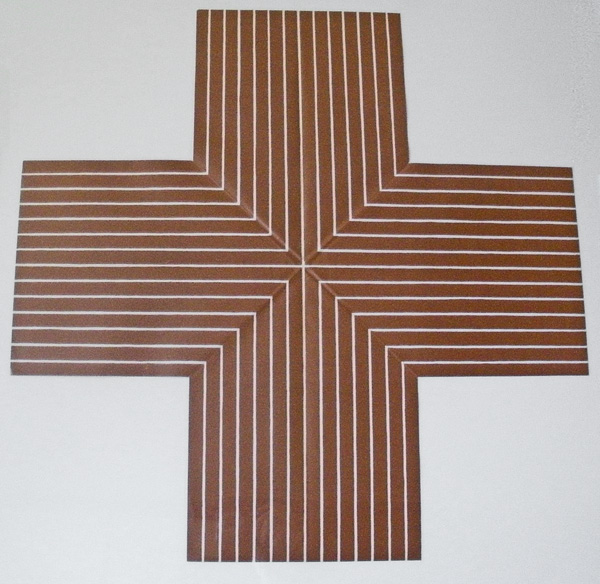
SPOTLIGHT: Frank Stella in 1962


verso


FRANK STELLA
(“Frank Stella: Paintings, Leo Castelli Gallery 4 East 77th Street, New York NY NY April 28 – May 19 [1962] Opening All Day”). 1962. Lithograph on die-cut paper printed in metallic ink (copper) on both sides. 17 ¾ x 17 ¾”. 

Conceived by the artist, this shaped exhibition poster commemorates Stella’s seminal, second one-person show at Leo Castelli Gallery. A condensation of Stella’s first two shows is presently re-gathered at L & M Arts, New York, the importance of which is described by Roberta Smith: “These works (from 1960 and 1962) represent the cornerstone of Mr. Stella’s reputation, the Stella whose historical importance, as with Picasso’s Cubist paintings, is most widely, if somewhat predictably, accepted…They hark back to a time when flatness was abstract painting’s primary goal, and the physical facts of the medium were starting to be endlessly parsed—beginning with shaped canvases—in a process that continues today. No artist’s work embodied these pursuits as rigorously as Mr. Stella’s; in the paintings at L & M, he laid down the tracks that others followed” (Roberta Smith, The New York Times, April 26, 2012). This elaborately conceived announcement published by Leo Castelli is shaped and inked in the manner of the artist’s canvases, and at this point, is arguably more difficult to come by than one of the artist’s notoriously rare Aluminum or Copper paintings. Very rare. In mint condition with no visible time staining. Take note of the back story: the unfolding, typographic lay-out on the verso of the 1962 announcement echoes Stella’s typographic, shape-shifting rhetoric operative in the paintings: when folded, the announcement forms the shape of an “L” (when opened, it otherwise forms the shape of a “T” or a crucifix). This linguistic transition—and ability to shapeshift--mirrors the transmogrification of Stella’s series of Aluminum and Copper paintings included in the 1962 show itself, many of which are shaped like alphabetic letters or as here, a cross. In other words, the concept / form / design of this early, Castelli-published offering functions just as the system of objects that it announces.  If not the holy grail, certainly the “cornerstone” foundation of both Stella’s work and early commitment to print.

© Todd Alden 2012                                                       Enquire

SPOTLIGHT: Ed Ruscha in 1964


(ED RUSCHA) (DENNIS HOPPER)
(“Ruscha”) (Double Standard).  Los Angeles: Ferus Gallery, 1964. Lithograph in black and green ink on white paper. 13 x 10”.  Folded as issued. 

This is the vintage exhibition poster commemorating Ed Ruscha’s second one-person exhibition that opened at Ferus on October 20th, 1964 and where Ruscha originally exhibited his paintings of gasoline stations for the first time. This printing constitutes the original reception context for his friend, Dennis Hopper’s now infamous 1961 photograph taken through a windshield at the intersection of Santa Monica and Melrose: it captures a pit stop to which Ruscha would return again: a Standard Station and its doubled signs. A billboard over the gasoline station reads: “Smart Women Cook with Gas in Balanced Power Homes,” slyly eliding Ruscha’s own interest in signs, wordplay, gasoline stations, and small fires evident in his then-recent works. The photographic image is juxtaposed not with the quotidian details of the exhibition’s place and time, but simply with the loud signal of an early Op-like typeface, honking the artist’s name in green ink: “RUSCHA”.

Although Dennis Hopper’s photographs were incorporated into several Ferus Gallery exhibition poster contexts, this one—whose vantage and subject dovetails so closely with the young Ruscha’s own aims—was both a familiar and uncanny choice. “The Double Standard photograph of mine,” Hopper recalled, “which I took in 1961 was Ed’s announcement for his 1964 show (at Ferus) of paintings of Standard gas stations, one of which I bought, I think, for $780.” That the double boomerang of Hopper and Ruscha’s photographic readymades depicting urban scrawl — gasoline stations, billboards/signs, wordplay, font-play, and more  finds cross-pollination in this particular and original ephemeral context is a combustible elixir of Los Angeles car, cool, fame, and flame. This perplexing publication is the authentic 1964 issue, printed in its vintage strike. Very good condition. With no pinholes or time staining. Not to be confused with the different printed context of Ace Gallery’s re-issue of Hopper’s negatives as over-sized, boutique art photographs in 2006. 

© Todd Alden 2012                                                       Enquire

SPOTLIGHT: Robert Rauschenberg in 1961


ROBERT RAUSCHENBERG
“(Robert) Rauschenberg: 2nd Week November”. New York: Leo Castelli, 1961 (November 7 – December 5, 1961).  Lithograph on heavy paper. Folded as issued. 22 ½ x 17 ½”. 

This printing conceived by Rauschenberg from a staged photograph of collaged detritus includes a stenciled photograph-with-the-photograph announcing his second one-person exhibition at Leo Castelli Gallery. According to the Rauschenberg Foundation, this is the first exhibition poster conceived by the artist, however, for Leo Castelli. This exhibition poster — if we can call it that  is created with the same collage tactics also deployed in the works exhibited at Castelli, only here it is a photographic readymade: it succeeds nearly as magnificently, too, falling ambiguously into the void between art and life.

Few exhibition announcements come as closely as this one does to nearly absenting itself from the workman-like task of exhibition poster design, one essential task of which is to announce the quotidian details of the exhibition’s place and time. Normally, the viewer is told where and when, but here, instead, he is compelled to become a detective: the name where the exhbition takes place  Castelli Gallery  is truncated to read only as “Castelli,” appearing only on a tiny, torn piece of paper lying inconspicuously among the staged, “found” trash. No precise gallery location or dates are provided (the verso is blank). A seemingly discarded photograph-within-the-photograph  is strewn on the ground, however, stenciled with the following cryptic clue: “2nd Week of November”.  Nowhere republished in the Rauschenberg literature and previously unknown to us, this very early Castelli publishing effort might be understood to also signal not only Rauschenberg’s passion for printed things, but also the ambitions of the extraordinary Castelli publishing program to follow. Folded, as issued. Mint condition. No time staining. Extremely rare. For reference: the original contact negative used by Rauschenberg to create this exhibition poster is reproduced in Robert Rauschenberg: Photographs 1949-1962, eds. Susan Davidson and David White (DAP: New York, 2011), p. 217.; the contact negative reproduced there was never issued, however, as a discrete “artwork”; this unsigned printing is the work itself.

© Todd Alden 2012                                                       Enquire

SPOTLIGHT: Marcel Broodthaers in 1969


MARCEL BROODTHAERS
Un coup de dés jamais n’abolira le hazard: Image. (Antwerp and Cologne: Wide White Space and Michael Werner Gallery, 1969).  32 pp.  Artist’s book, etc.  
From the edition of 300  

The book’s colophon reads as follows: “The model of this approximative image is the first edition of the poem, Un coup de dés jamais n’abolira le hasard by Stéphane Mallarmé published in 1914 by Librairie Gallimard.” The book as vessel was a great object of fascination for Broodthaers  indeed, one of the artist’s central concerns, a fact that has not been fully appreciated by the artist’s critics. He did not simply employ the book to fill with ideas or as an alternative distribution vehicle (as did most others makers of artist’s books from the 1960s and 1970s), but the Belgian was fascinated — like Mallarmé  by the diminishing poetics of mechanical printing, and by the form of the book itself.  Broodthaers frequently explored the book as “an object of prohibition” and Un coup de dés realizes the mystery of this enigma-wrapped-in-a-riddle more consequentially than anywhere else, perhaps, except for his rectified book of poetry, Pense Bête (1964). 

© Todd Alden 2012                                                       Enquire

SPOTLIGHT: Yves Klein in 1957-1959


YVES KLEIN
Timbre bleu (Blue Stamp). 1957-59. IKB pigment on postage stamp. 0.98 in. x 0.79 in.

Klein  originally created blue stamps to be sent through the mail  (in the place of official postage stamps) to announce a double exhibition at Iris Clert and Colette Alendy in 1957.  This is one of the unsent examples, thus retaining all of the “purity” of its IKB brilliance! This proposal, however modest in size, is a signal production in the history of both neo-avant-garde exhibition-making and of artist’s publicity.  “In many ways, (Yves Klein’s) stamps conformed with the usual ones: they were small, regulation-sized rectangles with perforated edges,” writes Sidra Stitch. “Unlike official stamps, however, they were totally blue, imageless, and devoid of any signifying information. They were thus a telling reversal of the commemorative stamp that features a depiction of someone or something, as well as a contrast to the pragmatic prerequisites of philatelic design practiced by modern governments...in the most modern sense, they were also logos, instantaneous signs, advertisements, components of a spectacle.” Fine and with excellent provenance.

© Todd Alden 2012                                                    Enquire


Alden Projects™: Booth 2.50


Alden Projects™ at NADA NYC 2012 (Booth 2.50)
Other Criteria, Other Matter


We are currently presenting unique works and a selection of rare and important artists’ ephemera, artist’s books, etc. by Art & Technology, John Baldessari, Marcel Broodthaers, John Chamberlain, Marcel Duchamp, Dan Flavin, Craig Kaufman, Ellsworth Kelley, Robert Irwin, Jasper Johns, Donald Judd, Yves Klein, Roy Lichtenstein, Piero Manzoni, John McCracken, Claes Oldenburg, Yvonne Rainer, Robert Rauschenberg, Ed Ruscha, Frank Stella and Andy Warhol.  

May 4-7, 2012
Center 548
548 West 22nd Street
between 10th and 11th Aves.
New York

Friday, May 4; 2pm to 8pm
Saturday, May 5; 11am to 8pm
Sunday, May 6; 11am to 6pm
Monday, May 7; 11am to 4pm

Free